

The Three Most Common Autoimmune Conditions
And Why This Matters More Than Ever

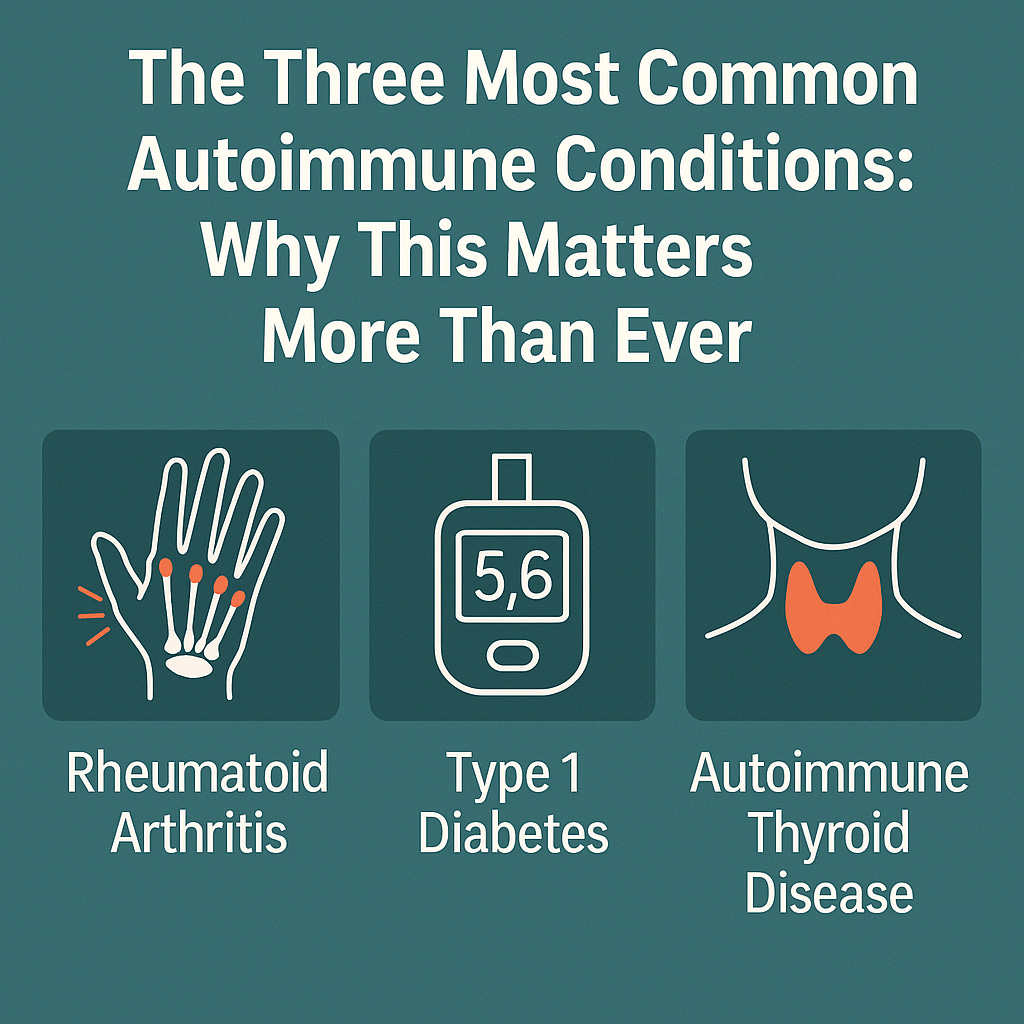
Autoimmunity isn’t a niche issue anymore. It’s mainstream — and the data backs it up. A recent population-based study out of the UK looked at 22 million individuals and found clear trends: the most common autoimmune conditions worldwide are rheumatoid arthritis, type 1 diabetes, and autoimmune thyroid diseases like Hashimoto’s thyroiditis and Graves’ disease [1–4].
Think about that: conditions that affect joints, blood sugar, and thyroid function top the list. That means we’re not talking about rare disorders in obscure textbooks — we’re talking about diseases that touch families in every community, every workplace, every church.
What the Data Actually Says
Rheumatoid Arthritis (RA): The most prevalent systemic autoimmune disease, marked by chronic joint inflammation and long-term disability if left unchecked [1–2].
Type 1 Diabetes Mellitus (T1DM): The most common autoimmune endocrine condition, driven by immune-mediated destruction of pancreatic beta cells [2–4].
Autoimmune Thyroid Disease (AITD): The most frequent organ-specific autoimmune condition. Hashimoto’s and Graves’ often co-occur with other autoimmune diseases, highlighting a shared genetic susceptibility [1–4].
These aren’t just random clusters of illness. The same genetic pathways show up across these diseases, meaning if someone has one autoimmune condition, they’re statistically more likely to develop another [3–4].
Why It Matters Beyond the Numbers
From a public health standpoint, this means autoimmune conditions aren’t isolated fires — we’re seeing a rising tide that cuts across demographics. From a clinical perspective, it reminds us to think whole-person, not just symptom-by-symptom. And from a marketing analysis standpoint (borrowing from what I unpacked in the Win Big Media study), it means messaging matters.
Patients don’t just want jargon about “shared susceptibility loci.” They want to know:
Why did this happen to me?
What can I do about it?
How do I avoid passing this along to my kids?
If we only talk science without story, we miss the real connection.
Where We Go From Here
The research is clear: autoimmune conditions are increasingly common, genetically linked, and socially impactful. But awareness is still low. The opportunity — whether you’re a clinician, researcher, or even a patient advocate — is to connect these dots for the public.
Because data doesn’t change lives — clarity does.
In health and happiness,
Dr. Cam
References
Conrad N, Misra S, Verbakel JY, et al. Incidence, Prevalence, and Co-Occurrence of Autoimmune Disorders… Lancet. 2023;401(10391):1878–1890.
Ali FHM, Smatti MK, Elrayess MA, et al. Role of Genetics in Eleven of the Most Common Autoimmune Diseases… Eur Rev Med Pharmacol Sci. 2023;27(18):8463–8485.
Frommer L, Kahaly GJ. Type 1 Diabetes and Autoimmune Thyroid Disease — the Genetic Link. Front Endocrinol. 2021;12:618213.
Zhernakova A, Withoff S, Wijmenga C. Clinical Implications of Shared Genetics and Pathogenesis in Autoimmune Diseases. Nat Rev Endocrinol. 2013;9(11):646–659.